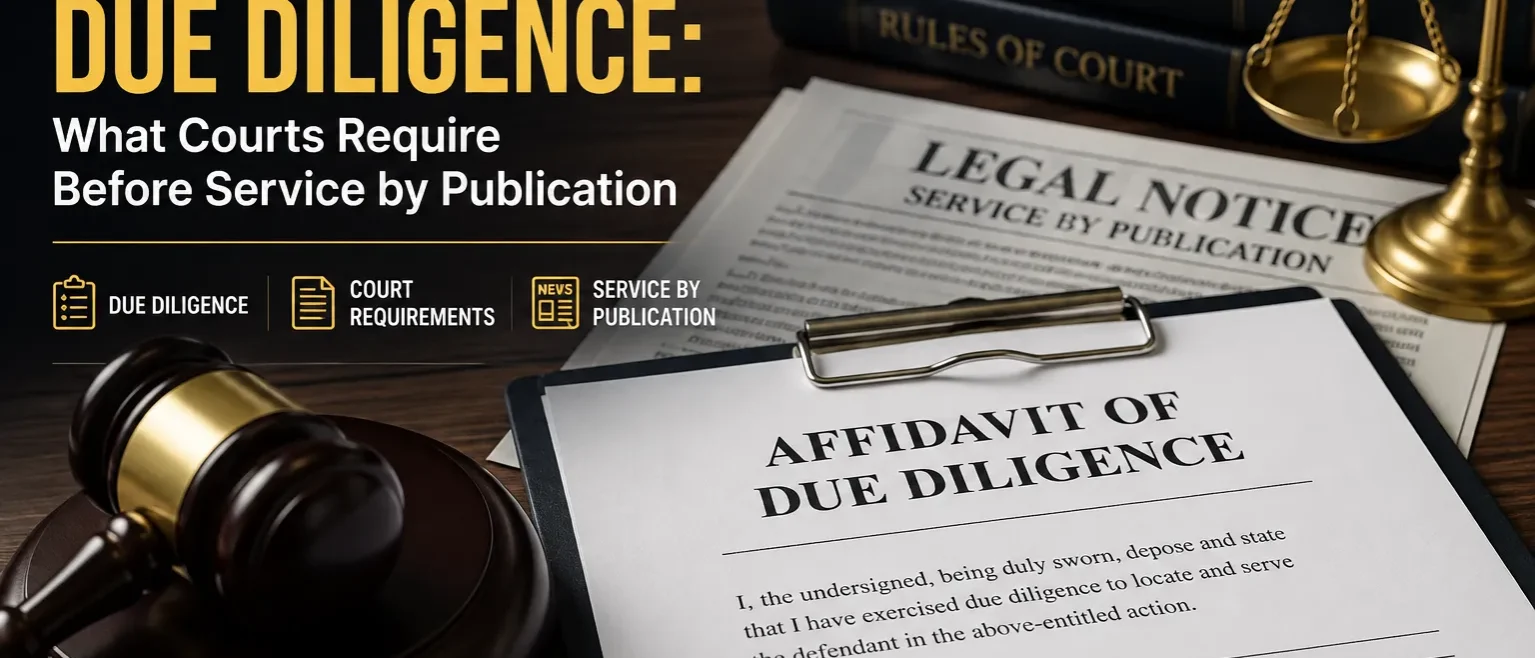
Trying to serve someone who has completely vanished is one of the most frustrating parts of any legal case.
You have a case that needs to move forward. But the other party cannot be found. They are not answering the door and changed their number. They moved with no forwarding address. Every day that passes, your case stalls. The legal clock keeps ticking, and you feel stuck.
In situations like this, the law allows for something called service by publication. Instead of handing papers to the person directly, you publish a notice in a newspaper and hope they see it. But here is the catch. You cannot just skip straight to publication. Courts will not allow it unless you prove you have genuinely tried everything else to find the person.
That is exactly what an affidavit of due diligence is for. It is your sworn statement to the judge that you have done everything reasonably possible to locate the defendant. You are telling the court: “I tried. I really did. And now I need another option.”
What Is an Affidavit of Due Diligence?
An affidavit of due diligence is a sworn legal document filed with the court. It details all the specific efforts you made to locate the defendant for service of process. Think of it as your investigative report. It lists every action you took, every address you visited, every person you contacted, and every database you searched.
This legal due diligence is the key that unlocks permission to serve someone by publication. Without it, a judge will not issue the order allowing you to publish that notice in the newspaper. The court needs to see that you did not take the easy way out. You did not just assume the person could not be found. You actually put in the work.
The core message of the affidavit is simple: service by publication is a last resort. You are demonstrating that you have exhausted all reasonable means to track this person down, and now you need the court’s permission to use an alternative method .
What the Court Expects in Your Due Diligence Process
The standard for what counts as acceptable due diligence is high. Courts do not just take your word for it. They want to see actual effort, documented clearly and thoroughly. Judges generally require “such diligence as a reasonable person under the same circumstances would use”. That means you need to show that you made a genuine, good-faith effort.
You cannot just say “I tried” and expect the judge to agree. The court wants to see a documented, systematic search. And your affidavit of due diligence should read like a detailed timeline of your investigative efforts.

A well-crafted affidavit should outline concrete actions, such as:
- Physical inquiries. You need to show you attempted service at the defendant’s last known residential and business addresses. And not just once. Courts want to see multiple attempts at different times of day—morning, afternoon, evening, and even weekends. Each attempt should be logged with a date, time, and result.
- Public record searches. You need to check databases like DMV records, voter registration, property records, and professional licensing boards. These searches can reveal new addresses or contact information that the defendant may not have shared.
- Contacting acquaintances. You should reach out to known relatives, friends, former employers, or neighbors. Sometimes people know where someone went even if they do not want to say directly. Document every conversation you had and what you learned.
- Digital searches. Use social media platforms, online search engines, and skip-tracing databases. People often leave digital footprints even when they disappear from physical locations. A Facebook post, LinkedIn profile, or Instagram location tag can reveal a current city or workplace.
- Postal verification. Attempt to secure a forwarding address from the USPS . If the person moved, the postal service may have a record. This shows you tried to find them through official channels.
Here is the thing about specificity. It makes all the difference. Instead of stating “I searched for the defendant,” it is much more compelling to state “I attempted service at 123 Main St. on three separate dates, called the defendant’s mother, and ran a DMV search with no results”. Some jurisdictions even expect process servers to log their attempts with photos, GPS coordinates, and specific timestamps to prove they were actually there .
Filing the Affidavit and Getting a Court Order
Once you have documented your efforts, you must submit the due diligence affidavit to the court alongside a motion for an order of publication. Many jurisdictions provide specific forms for this purpose, but the core requirement remains the same: provide an exhaustive, honest, and detailed list of your search efforts.
If a judge is satisfied that your diligence was sufficient, they will sign an Order for Service by Publication. This order authorizes you to publish the legal notice in a newspaper. You must then follow the court’s exact instructions regarding which newspaper to use and the publication schedule, which is typically once a week for four consecutive weeks. After that, the court considers the defendant officially served, even if they never actually saw the notice.
Frequently Asked Questions
What is an affidavit of due diligence for service by publication?
An affidavit of due diligence is a sworn statement filed with the court that proves you made reasonable efforts to personally serve the defendant before asking for permission to use service by publication. It lists every action you took to locate the person.
What is the due diligence process for service by publication?
The due diligence process involves making thorough, documented efforts to locate the defendant. This includes searching public records, visiting known addresses, contacting relatives and neighbours, using online resources, and checking with the postal service. All of this must be detailed in the affidavit.
What are the service by publication requirements in court?
Courts require you to file an affidavit of due diligence and get a court order authorizing the publication. That order will spell out which newspaper to use and how many weeks the notice has to run before you can move forward with your case.
What happens if a judge finds my due diligence insufficient?
If the judge decides you didn’t try hard enough, they’ll deny the request for service by publication. You’ll have to go back, do a more thorough search, file a new and more detailed affidavit, and then ask the court to reconsider.
Can I use service by publication without an affidavit?
No. You cannot legally serve by publication without first filing an affidavit of due diligence and receiving a court order. Attempting publication without these steps is considered invalid service and could jeopardize your case later.